
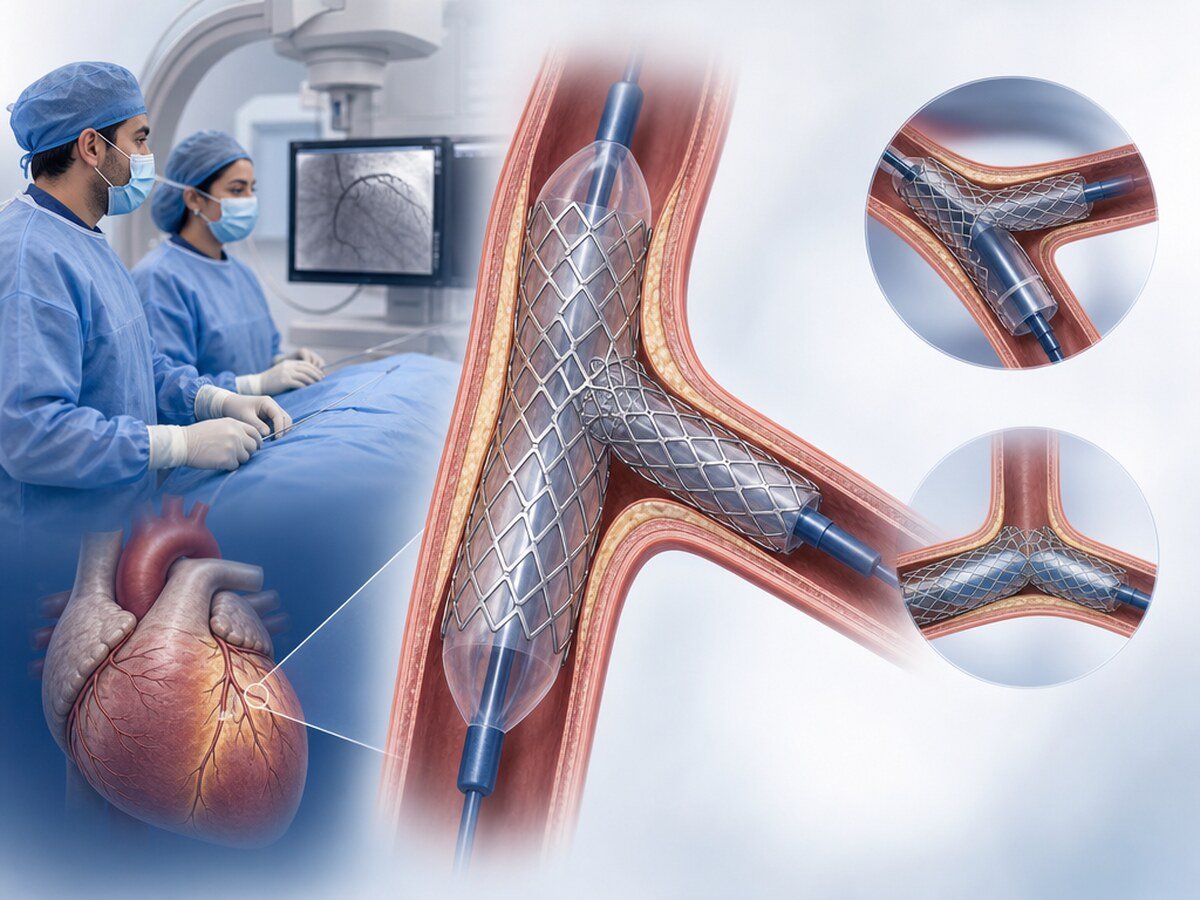
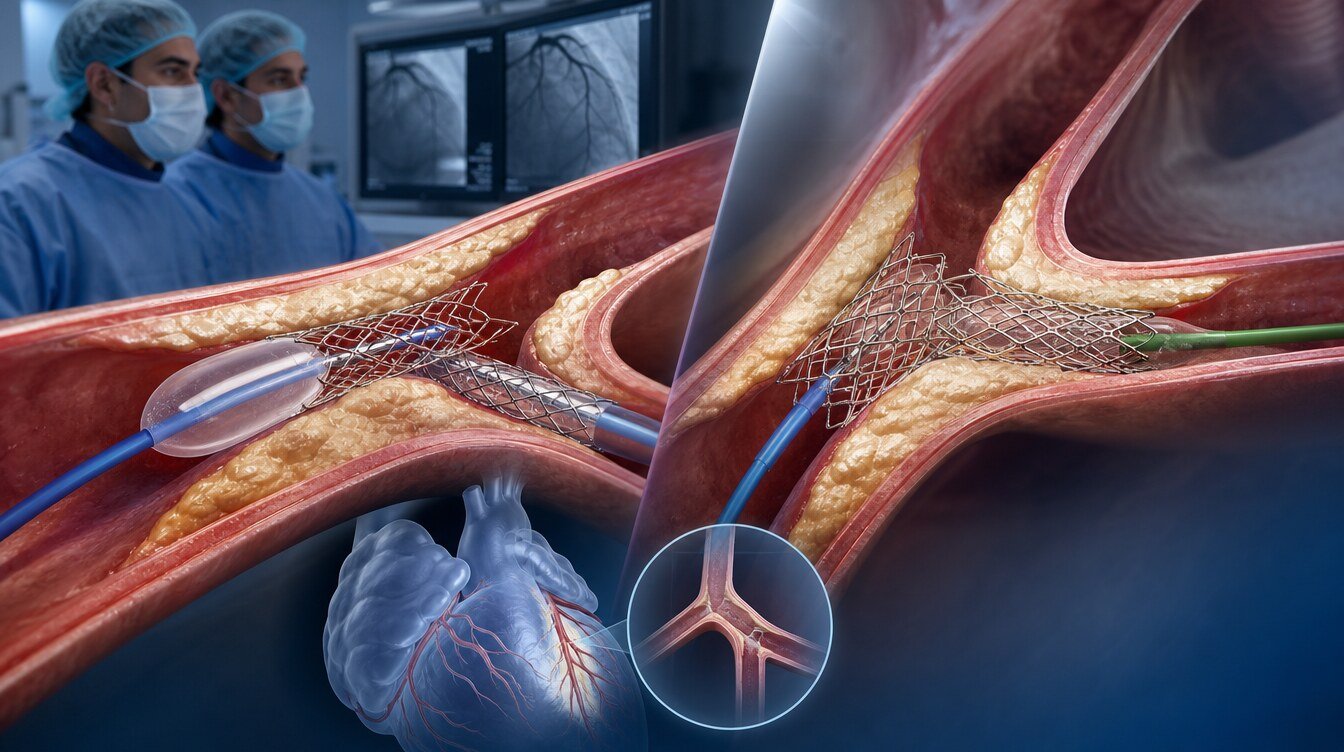
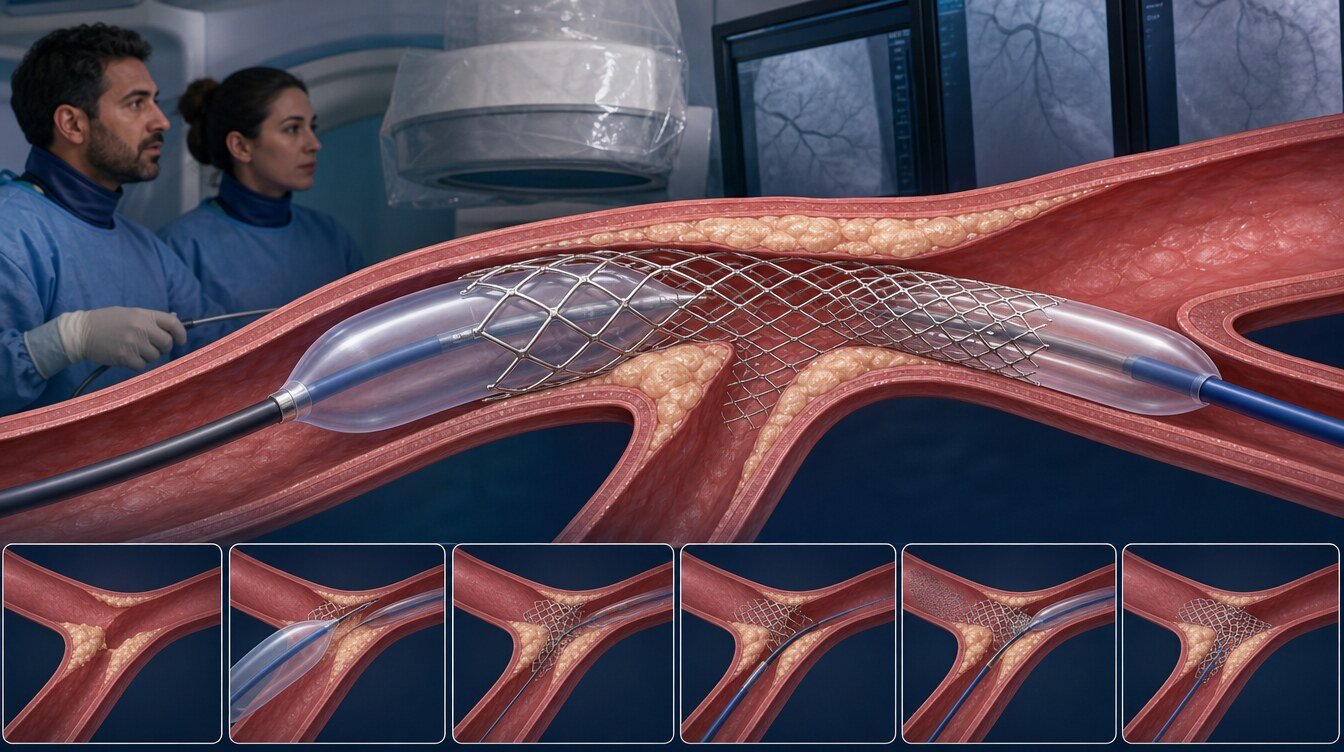
DK crush (double kissing crush) is a planned two-stent technique for coronary bifurcations. The EBC 18th consensus calls it complex and states that it can only end safely with both stents implanted and final kissing balloon inflation performed. Crush and re-crush operator steps are not published here.[1]
The overall frame is on bifurcation and LMCA interventions. For the stepwise one-stent philosophy see provisional stenting.
What does DK crush mean?
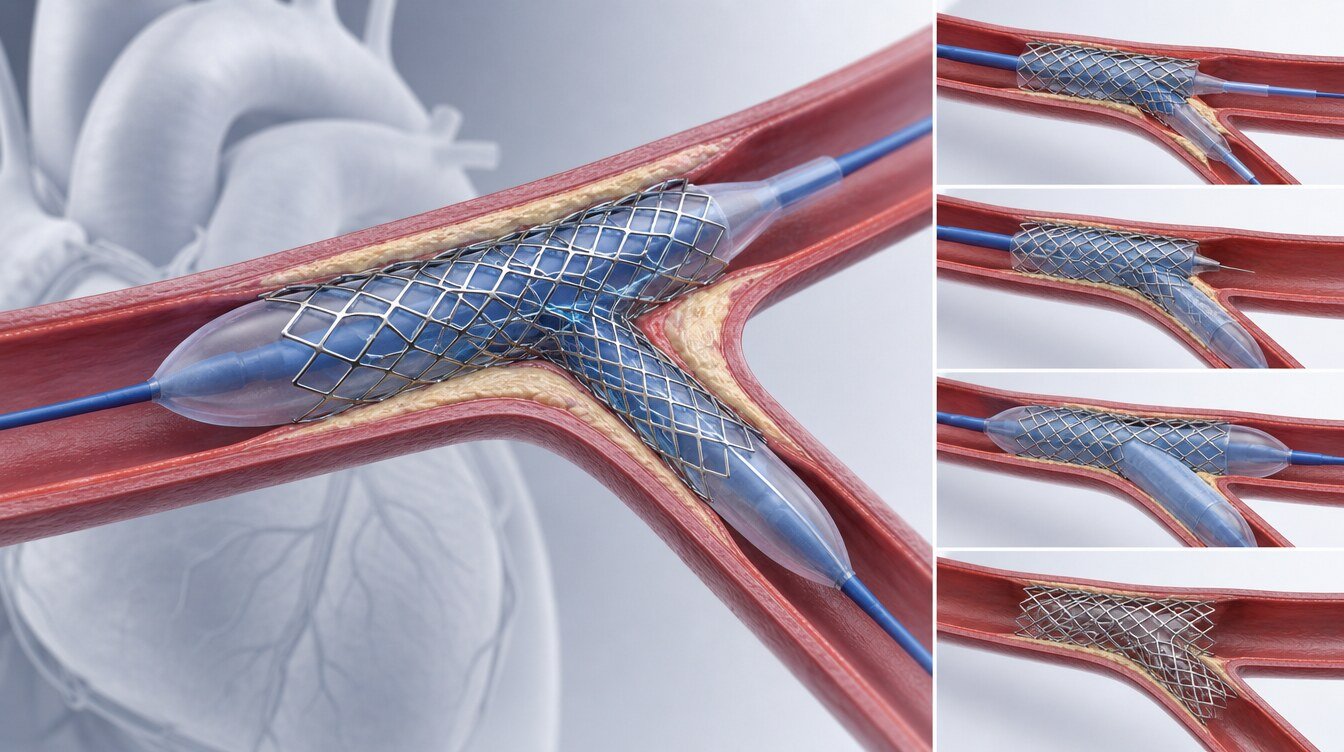
Two stents are planned to cover both branches. “Double kissing” refers to two overlapping balloon inflations during the procedure. The EBC notes that multiple strut layers across the side-branch ostium can make kissing harder and advises limiting overlap. That is a patient-level safety caution, not a device sequence.[1]
Which anatomy is it considered in?
Randomised evidence is concentrated in true bifurcations that also involve the side branch. DKCRUSH-V enrolled 482 patients with true distal left main bifurcations classified Medina 1,1,1 or 0,1,1 across 26 centres in five countries. DEFINITION II enrolled DEFINITION-criteria complex bifurcations; DK crush was used in 77.8% of the two-stent arm. These populations are selected and do not transfer to simple bifurcations.[2,6]
The EBC places DK crush especially when the target vessel is the left main and PCI is performed by high-volume operators. The DKCRUSH-X authors also note that investigator experience in both techniques may limit generalisability.[1,7]
What was found versus provisional stenting?
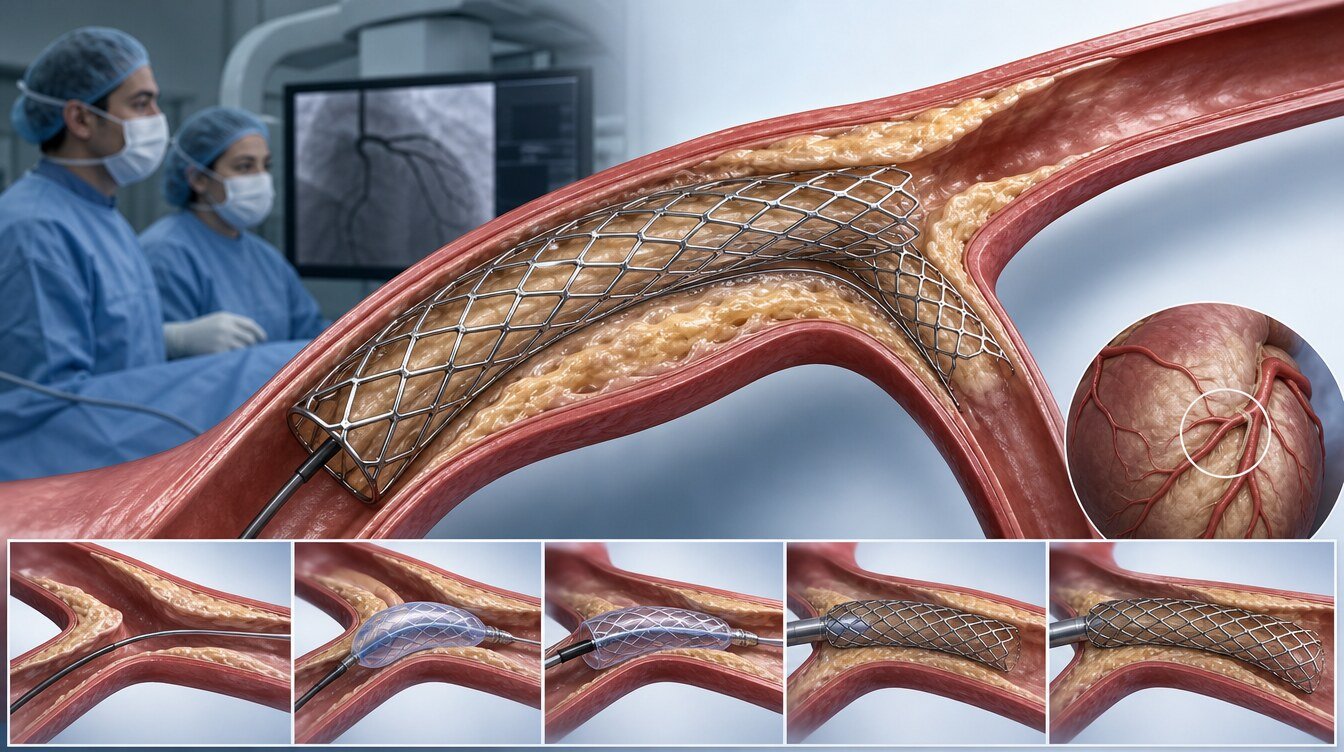
In DKCRUSH-V, 1-year target lesion failure was 10.7% with provisional versus 5.0% with DK crush (HR 0.42). Target-vessel MI was 2.9% versus 0.4% and definite or probable stent thrombosis 3.3% versus 0.4%. There was no significant difference in cardiac death. At three years target lesion failure was 16.9% versus 8.3% (p=0.005). The one- and three-year papers are the same 482 patients and must not be added. The trial was open-label.[2,3]
DKCRUSH-II, in 370 unselected bifurcations, found 12-month MACE of 17.3% versus 10.3% (p=0.070, not significant). The authors state there was no significant MACE difference. Additional side-branch stenting was required in 28.6% of provisional lesions.[8]
DEFINITION II found 1-year target lesion failure of 11.4% with provisional versus 6.1% with systematic two stents (HR 0.52). Cardiac death was 2.5% versus 2.1%, not significantly different. The three-year report is the same 653 patients.[6,9]
DKCRUSH-X pools 1,573 patients from four DKCRUSH trials. Six-year target lesion failure was 18.2% with two stents versus 24.7% with provisional. Those patients already sit in the component rows. Median contrast was 200 mL versus 180 mL and procedure time 66 versus 56 minutes.[7]
Did another randomised trial find a different result?
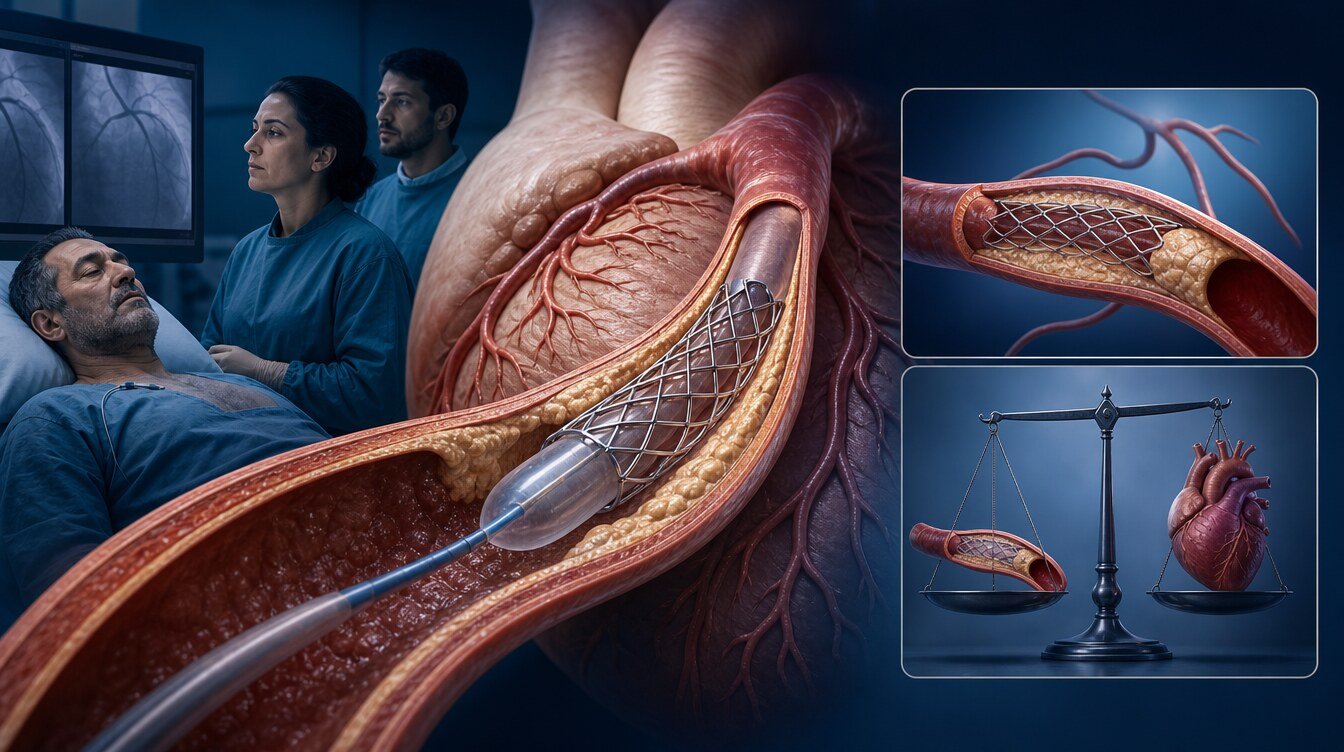
Yes. EBC MAIN randomised 467 patients with true left main bifurcations to stepwise provisional or systematic dual stenting. The 12-month composite of death, myocardial infarction and target lesion revascularisation was 14.7% versus 17.7% (HR 0.8; p=0.34). At three years the primary endpoint was 23.5% versus 29.5% (p=0.11); target lesion revascularisation was lower with stepwise provisional (8.3% versus 15.6%). The three-year paper is the same cohort.[4,5]
The two trials enrolled comparable true distal left main populations (482 and 467) and point in different directions. Design, operator and strategy differences exist. The disagreement is not hidden and is not closed with “DK crush is the proven best technique”. Medical review must sign off this framing before the page is treated as final.[1,2,4]
Comparison with culotte is on the culotte page; there is no adequately powered randomised TAP-versus-DK crush comparison in left main disease (T-stenting).
What are the drawbacks?
A planned two-stent procedure generally takes longer and uses more contrast, which matters most when kidney function is reduced. Completing the technique and operator experience are more critical. Multiple metal layers can make kissing harder. No DK crush-specific Class/LOE was found in this package; the frame is consensus.[1,7]
The procedure is done in a coronary angiography setting with a stent. Preparation of calcified stenoses is a separate topic.
Risks and emergency warnings
Two-stent bifurcation PCI carries the general risks of stenting. Same-day discharge is not promised. Call 112 for bleeding that will not stop, severe chest pain that does not settle, or impaired circulation in the access limb.
Frequently asked questions
Provisional starts with one stent; DK crush plans two stents from the start and must be completed in full.[1]
No. It pools the component trials; patients must not be counted again.[7]
There is no universal ranking. Left-main DKCRUSH-III is a separate comparison with a different population and crush technique.[1]
No DK crush-specific Class/LOE was found in the retrieved ACC/ESC texts; the frame is consensus.
For bleeding that will not stop, severe chest pain that does not settle, or a cold or numb limb on the puncture side.
Assessment and decision
DK crush is a planned two-stent option in selected true bifurcations. Technical success and repeat procedures are read separately from death. EBC MAIN stands beside DKCRUSH-V; a single trial is not a universal rule.[1–5]
Literature
References
Burzotta F, et al. EBC 18th consensus. EuroIntervention. 2024. DOI: 10.4244/eij-d-24-00160.
Chen SL, et al. DKCRUSH-V. J Am Coll Cardiol. 2017. DOI: 10.1016/j.jacc.2017.09.1066. PMID: 29096915.
Chen X, et al. DKCRUSH-V 3-year. JACC Cardiovasc Interv. 2019. PMID: 31521645. Same 482 patients.
Hildick-Smith D, et al. EBC MAIN. Eur Heart J. 2021. DOI: 10.1093/eurheartj/ehab283. PMID: 34002215. NCT02497014.
Arunothayaraj S, et al. EBC MAIN 3-year. Circ Cardiovasc Interv. 2025. PMID: 39907022. Same cohort; DOI not verified in this package.
Zhang J, et al. DEFINITION II. Eur Heart J. 2020. DOI: 10.1093/eurheartj/ehaa543. PMID: 32588060.
Chen SL, et al. DKCRUSH-X pooled IPD. AsiaIntervention. 2025. DOI: 10.4244/aij-d-25-00021. Overlapping cohorts.
Chen SL, et al. DKCRUSH-II. J Am Coll Cardiol. 2011. DOI/PMID not verified in this package.
Kan J, et al. DEFINITION II 3-year. JACC Cardiovasc Interv. 2022. DOI: 10.1016/j.jcin.2022.05.026. PMID: 35798473. Same 653 patients.
NHS. Coronary angioplasty — Recovery. Official patient page. Accessed 27 August 2026.
This content is for general information only and does not replace personalized medical advice. In emergencies call local emergency services.
Continue