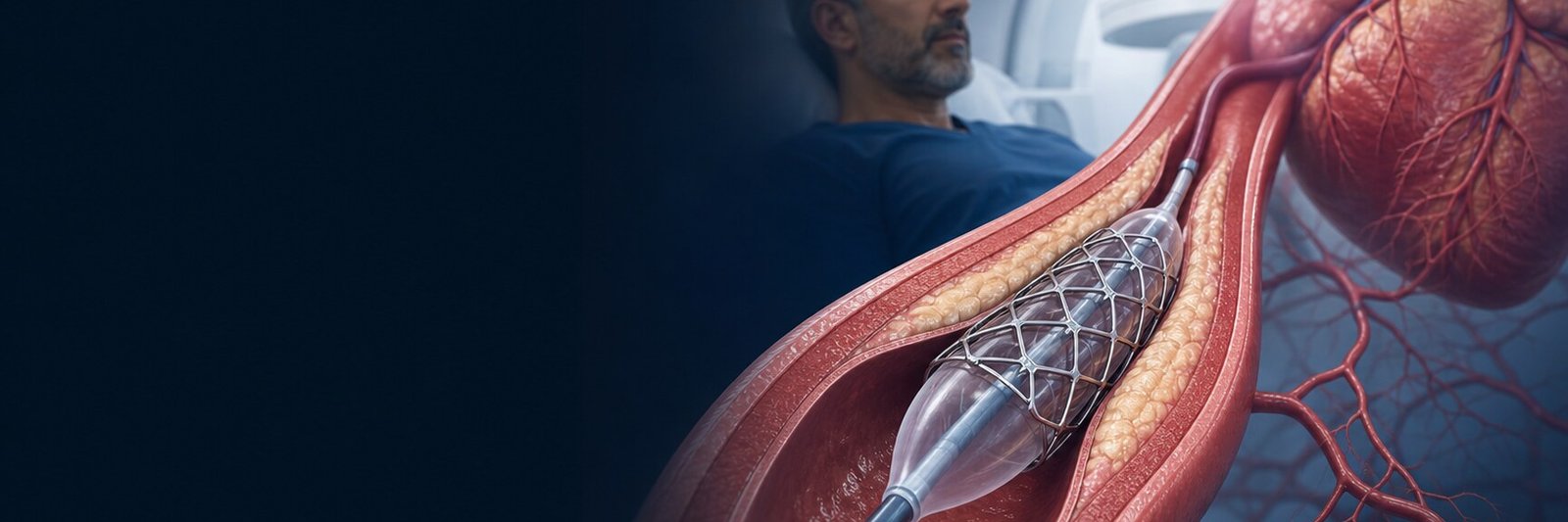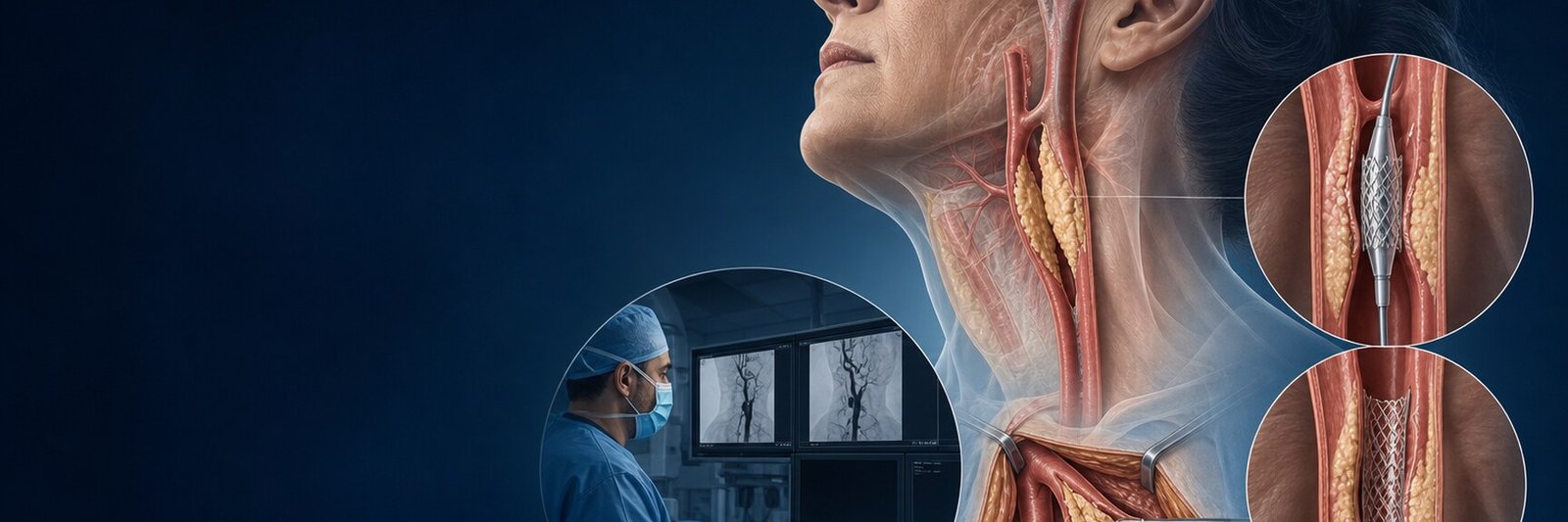
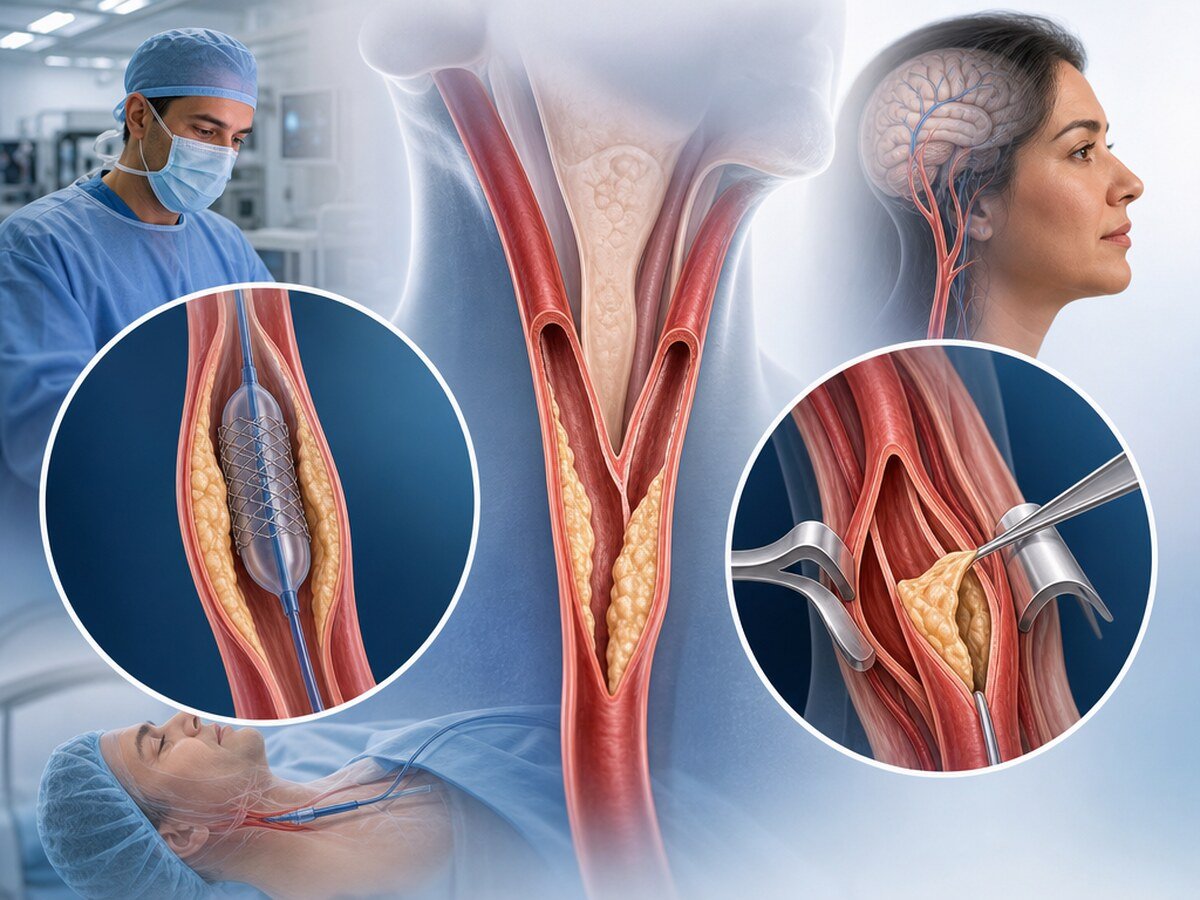
Carotid stenosis is narrowing of the neck arteries that carry blood to the brain, caused by plaques of cholesterol and calcium on the inner wall. Treatment depends on the degree of narrowing, whether a transient ischaemic attack or stroke has occurred, age and vessel anatomy. In some people intensive medicine and lifestyle care are enough; in suitable people, surgical removal of the plaque or placement of a stent may be considered.[1]
This page is not the same disease as peripheral artery disease and stenting. Results from leg-artery trials are not transferred to the carotid.
Why does carotid stenosis matter?
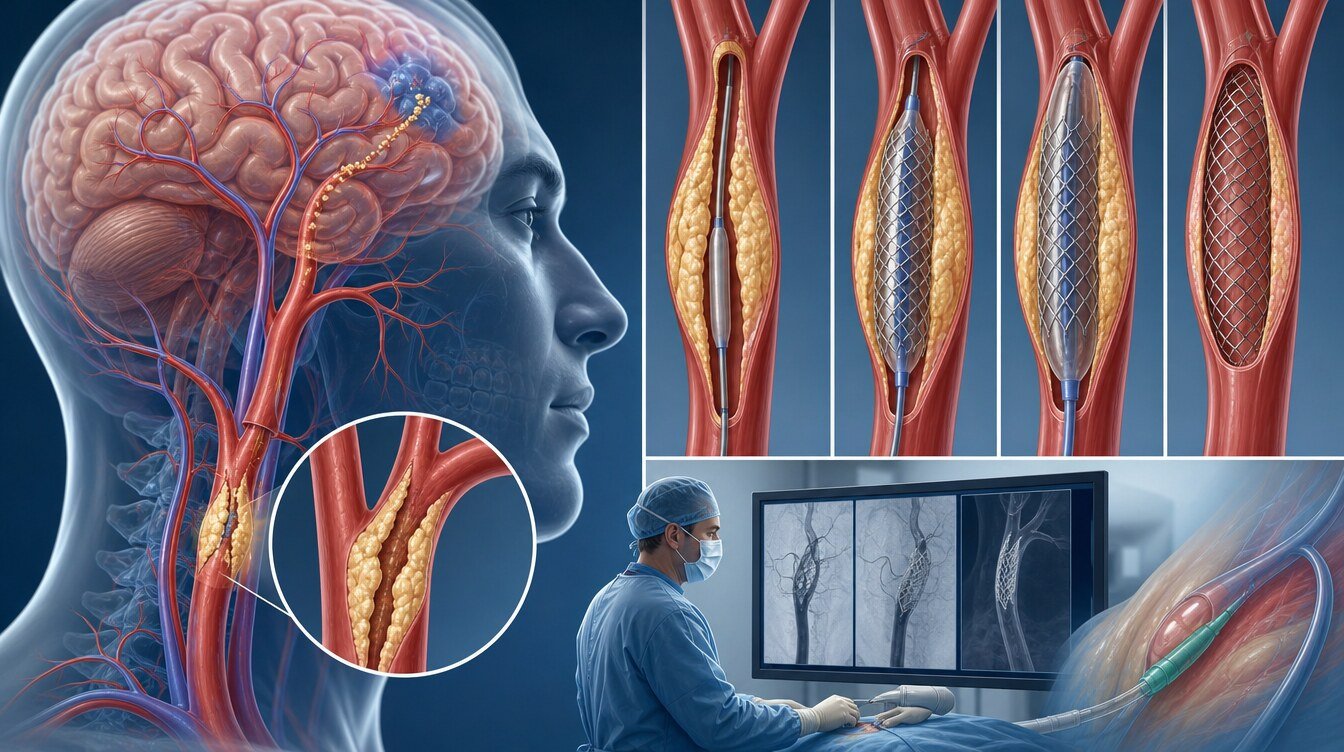
The carotid arteries are large vessels that carry blood from the heart to the brain. Narrowing is usually due to atherosclerosis. Small clot fragments can break from the plaque surface and block brain arteries, or flow to the brain can fall when the vessel is very tight. The result can be a transient ischaemic attack (TIA) or a lasting stroke. Carotid stenosis accounts for only part of ischaemic strokes; heart-rhythm disorders and small-vessel disease of the brain should also be investigated.[1]
Three different clinical situations
The most important point for a treatment decision is whether the person has had a recent neurological symptom.
Asymptomatic carotid stenosis
Asymptomatic stenosis means there has been no recent TIA, stroke or temporary loss of vision in one eye related to that carotid artery. The narrowing may be found on an ultrasound done for another reason. The foundation is intensive medical therapy. The percentage alone is not enough; plaque features, brain imaging, life expectancy and procedural risk are assessed together.[1,5]
SPACE-2 was under-recruited and did not prove that endarterectomy or stenting was superior to best medical therapy alone at five years.[5]
CREST-2 consists of two parallel randomised trials in selected asymptomatic stenosis of 70 percent or more and has been published in the New England Journal of Medicine. Stenting plus intensive medical therapy reduced the four-year primary composite (any stroke or death to day 44, then ipsilateral ischaemic stroke) compared with medical therapy alone (2.8% versus 6.0%; P=0.02). In the parallel endarterectomy trial the difference was not statistically significant (3.7% versus 5.3%; P=0.24). Strokes and one death still occurred in the stenting arm in the periprocedural period. This does not mean that every severe asymptomatic narrowing needs a stent, that stenting is better than surgery, or that medical therapy can be stopped.[6]
Symptomatic carotid stenosis
Symptomatic stenosis usually means a related TIA, stroke or temporary loss of vision in one eye within the past six months. The risk of a further stroke can be higher in the first days and weeks. In suitable people, carotid endarterectomy is recommended for consideration, preferably within two weeks of the last neurological event. Revascularisation is often strongly considered for 70–99% symptomatic stenosis; at 50–69% the decision is individualised.[1]
Stenting can be an option for some symptomatic people. In randomised comparisons, especially above age 70, the risk of stroke or death around the procedure has been higher with stenting than with endarterectomy.[2,9]
Mechanical thrombectomy in acute stroke
Mechanical thrombectomy is retrieval of a clot from a suddenly blocked large brain artery. It is not the same as planned carotid stenting. In some special situations a carotid stent may also be needed in the same session; that decision belongs to the emergency stroke team.
How is carotid stenosis diagnosed?
Duplex ultrasound is the first painless test and does not use radiation. The result can be affected by the machine, the operator, tortuous vessels and neck shape; before an important treatment decision it is usually confirmed with CTA or MRA. Brain CT or MRI helps show whether damage matches the carotid narrowing. Heart rhythm and other stroke causes should also be assessed.[1]
The percentage of narrowing is most often expressed with the NASCET method: the tightest diameter is compared with the normal diameter beyond the narrowing. Roughly, below 50% is mild, 50–69% moderate, 70–99% severe and 100% is complete occlusion. Different methods can produce different numbers. The decision is not made from the percentage alone.[1]
Treatment options
Intensive medical therapy
Optimal medical therapy is not a single medicine: antiplatelet medicines as the clinician advises, cholesterol and blood-pressure control, diabetes care, stopping smoking, diet, suitable physical activity and management of other vascular risks. Dose and duration are individual; a medicine should not be started or stopped without advice.[1] Cholesterol treatment concerns the heart arteries as well as a carotid plaque.
Carotid endarterectomy
Carotid endarterectomy (CEA) is surgical removal of the plaque through a neck incision. It is the method with the strongest randomised evidence in symptomatic people whose anatomy is suitable. Risks include stroke, death, myocardial infarction, a collection of blood in the neck, infection and cranial-nerve injury (hoarseness, swallowing difficulty, a change in tongue movement).[1,2]
Transfemoral carotid artery stenting
Transfemoral carotid artery stenting (TF-CAS) advances a catheter from the groin to the carotid and places a stent. Embolic-protection devices may be used to reduce the chance that fragments reach the brain during the procedure.
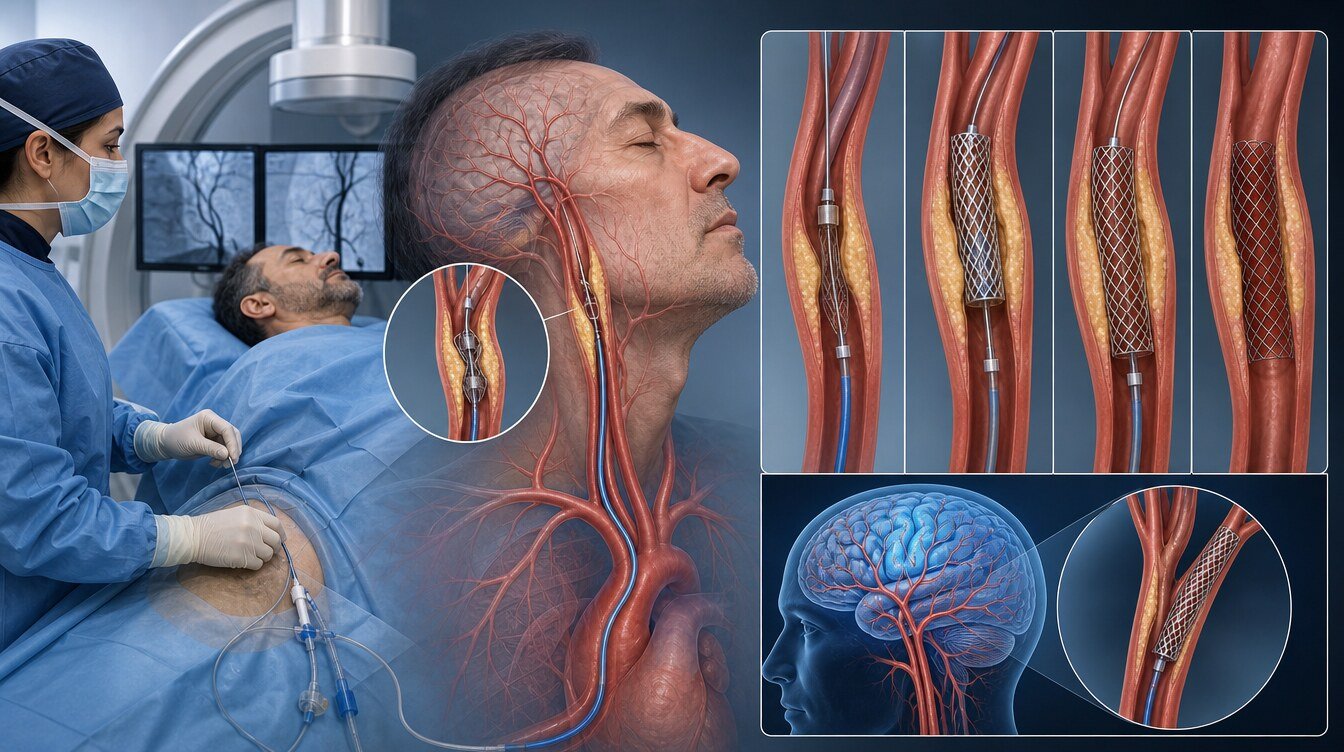
In CREST, the periprocedural stroke rate was 4.1% with stenting and 2.3% with endarterectomy; the myocardial-infarction rates were 1.1% and 2.3%. Those figures are not a personal risk and cannot be applied directly to every centre today.[2] At 10 years, CREST did not show a significant difference between the methods for the composite of periprocedural events and later ipsilateral stroke.[3] EVA-3S is a separate randomised trial in symptomatic severe stenosis that found a higher periprocedural stroke risk with stenting; it must not be silently pooled with CREST.[9] ACT I compared stenting with surgery in asymptomatic stenosis already judged to need a procedure; there was no medical-therapy-only arm.[8]
In ACST-2, among selected people with severe asymptomatic stenosis already chosen for a procedure, the five-year rate of fatal or disabling non-procedural stroke was 2.5% in both groups; any non-procedural stroke was 5.3% with stenting and 4.5% with endarterectomy, and the difference was not significant.[4]
TCAR through a small neck incision
Transcarotid artery revascularisation (TCAR) reaches the carotid through a small neck incision and tries to reverse flow briefly while a stent is placed. Avoiding a long catheter path along the aortic arch is described as an advantage. In the ROADSTER 2 registry the composite 30-day stroke or death rate was 0.8% in the 632-person per-protocol group; this is not long-term randomised evidence and is not treated as equal to CEA or TF-CAS.[7]
How is the method chosen?
Symptom status, timing, the NASCET percentage, age, neck and aortic-arch anatomy, surgical risk, plaque features, life expectancy, centre experience and the person’s preference are assessed together. In CREST, results favoured CEA more clearly in people older than 70.[2] A stent or endarterectomy is usually not suitable in a completely occluded carotid artery.
Before the procedure, the hospital stay and follow-up
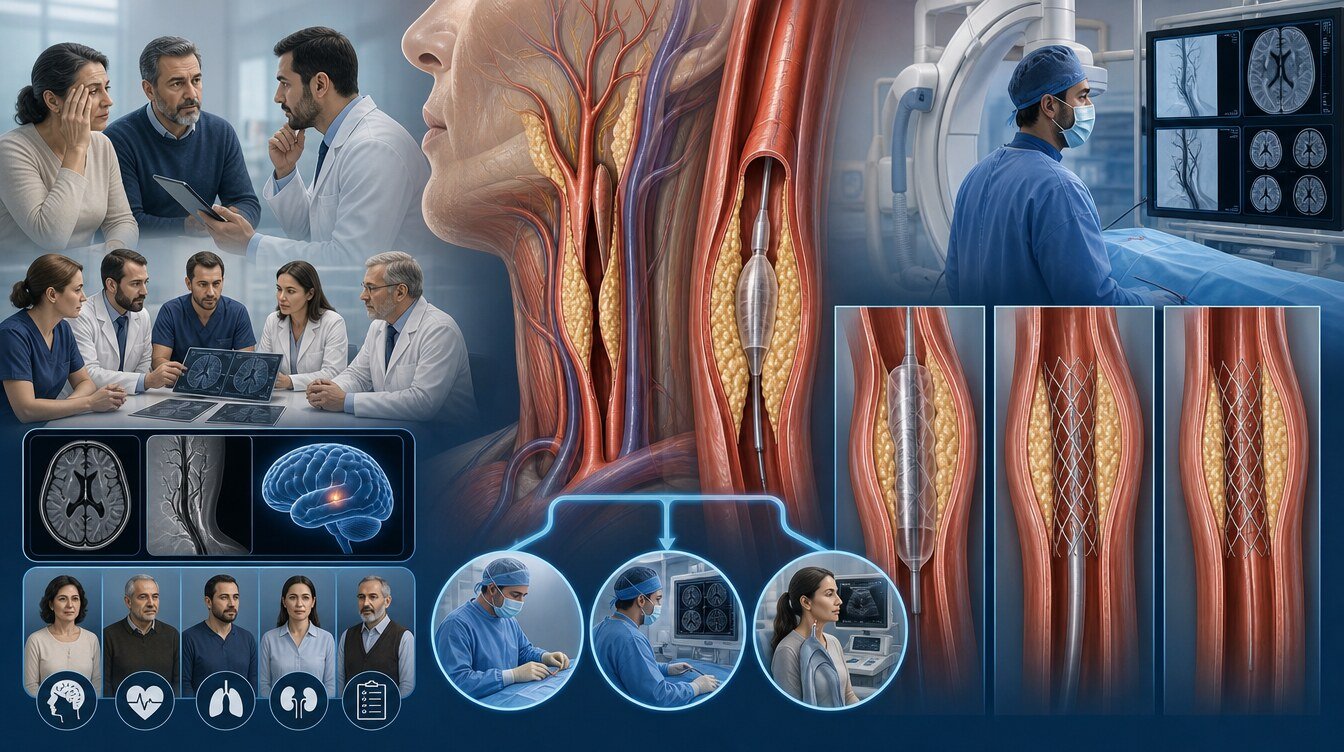
Medicines in use, bleeding history, allergy, kidney disease and previous operations should be reported. Blood thinners should not be stopped on a person’s own decision. After CEA, TF-CAS or TCAR, blood pressure, rhythm and the neurological state are watched. Increasing neck swelling, difficulty breathing or swallowing, bleeding that will not stop, new weakness, speech disturbance or loss of vision needs urgent contact. Restenosis is re-narrowing in a previously treated segment; follow-up intervals are individual.[1,5]
Emergency stroke symptoms
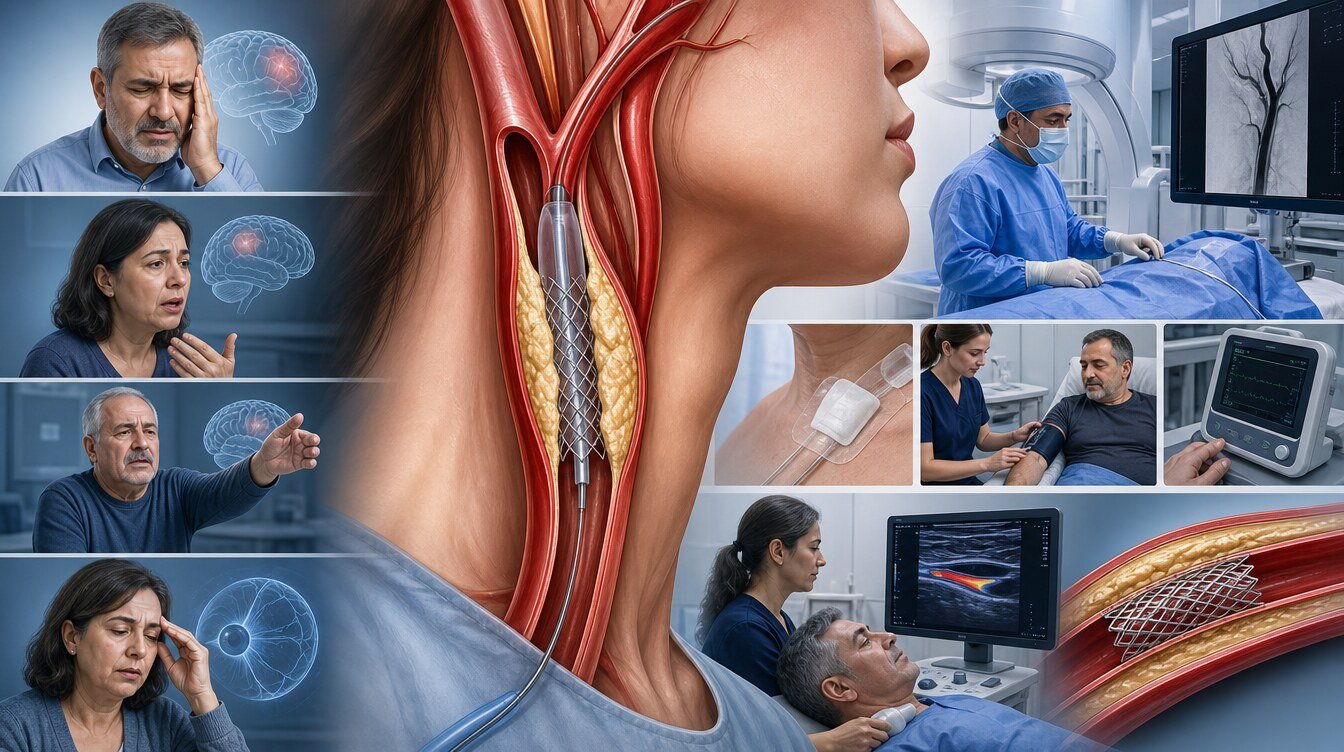
Call emergency help, even if the symptom has gone, if one side of the face droops, an arm or leg suddenly weakens or goes numb, speech is disturbed, vision is suddenly lost, balance is suddenly lost, or a severe headache that was not there before appears. Note the time the symptoms started.[1]
Questions for the heart and vessel team
- What is my stenosis as a NASCET percentage?
- Is the narrowing asymptomatic or symptomatic?
- Could intensive medical therapy alone be enough for me?
- What are my specific risks with CEA, TF-CAS and TCAR?
- If a procedure is advised, what absolute stroke, death and heart-attack risks are expected?
- After the procedure, which medicines will I take and for how long?
Academic context of Prof. Dr. Hakan Uçar
Among the sources that could be verified for this package, no confirmed carotid-stenosis or carotid-stenting paper by Prof. Dr. Hakan Uçar was found. No specific scientific paper, method or success rate in carotid disease is therefore attributed to him. PAD papers are not used as carotid evidence.
Frequently asked questions
No. In many people the first and continuing approach is intensive medical therapy, risk-factor control and regular follow-up. A stent is considered only in defined clinical and anatomical settings.[1]
Dizziness has many causes and dizziness alone does not usually prove carotid stenosis. Sudden loss of balance, speech disturbance or weakness needs emergency assessment.
A 70 percent narrowing is classed as severe; the treatment decision depends on whether there have been symptoms, the measurement method, age, anatomy and procedural risk.[1]
An operation or stent is not automatic in asymptomatic stenosis. Intensive medical therapy is the foundation. In selected high-grade stenosis, the CREST-2 stenting trial reduced a composite stroke outcome; the parallel endarterectomy trial did not show a significant difference. That does not mean every 70 percent narrowing needs a stent.[5,6]
Antiplatelet therapy is needed to reduce clot forming inside the stent. The type and duration are individual; no medicine should be stopped without a clinician’s advice.[1]
Local anaesthesia, sedative medicines or other anaesthetic methods may be used according to the procedure and the centre. The method that suits you is explained beforehand.
TCAR uses a different access route. ROADSTER 2 is a registry; it does not have long-term randomised evidence equal to CEA or transfemoral stenting.[7]
The tendency to atherosclerosis can continue. A procedure can reduce a narrowing, but if blood pressure, cholesterol, smoking and diabetes are not controlled, new plaques can form in other arteries.[1]
No. No treatment sets the risk to zero. Treatment aims to reduce risk in suitable people; heart rhythm and other stroke causes still need to be checked.[1]
No single interval suits everyone. The clinician sets a follow-up plan from the degree of narrowing, the type of procedure and previous imaging.
Physical activity suited to the person’s heart and neurological state is usually helpful. People who have had a recent stroke or are in the post-procedure period should agree an exercise plan with their clinicians.
If the decision is not urgent, a second opinion can help, especially in asymptomatic stenosis or when more than one procedure is possible. Imaging and neurological records should be reviewed together.
No. Temporary symptoms can be a TIA and a warning that a lasting stroke may follow. Emergency assessment is needed even if the symptom has gone.[1]
Literature
References
Naylor R, Rantner B, Ancetti S, et al. European Society for Vascular Surgery (ESVS) 2023 Clinical Practice Guidelines on the Management of Atherosclerotic Carotid and Vertebral Artery Disease. European Journal of Vascular and Endovascular Surgery. 2023;65:7–111. DOI: 10.1016/j.ejvs.2022.04.011
Brott TG, Hobson RW, Howard G, et al. Stenting versus Endarterectomy for Treatment of Carotid-Artery Stenosis. New England Journal of Medicine. 2010;363:11–23. DOI: 10.1056/NEJMoa0912321
Brott TG, Howard G, Roubin GS, et al. Long-Term Results of Stenting versus Endarterectomy for Carotid-Artery Stenosis. New England Journal of Medicine. 2016;374:1021–1031. DOI: 10.1056/NEJMoa1505215
Halliday A, Bulbulia R, Bonati LH, et al. Second asymptomatic carotid surgery trial (ACST-2): a randomised comparison of carotid artery stenting versus carotid endarterectomy. The Lancet. 2021;398:1065–1073. DOI: 10.1016/S0140-6736(21)01910-3
Reiff T, Eckstein HH, Mansmann U, et al. Carotid endarterectomy or stenting or best medical treatment alone for moderate-to-severe asymptomatic carotid artery stenosis: 5-year results of SPACE-2. Lancet Neurology. 2022;21:877–888. DOI: 10.1016/S1474-4422(22)00290-3
Brott TG, Howard G, Lal BK, et al. Medical Management and Revascularization for Asymptomatic Carotid Stenosis. New England Journal of Medicine. 2026;394:219–231. DOI: 10.1056/NEJMoa2508800
Kashyap VS, Schneider PA, Foteh M, et al. Early Outcomes in the ROADSTER 2 Study of Transcarotid Artery Revascularization in Patients With Significant Carotid Artery Disease. Stroke. 2020;51:2620–2629. DOI: 10.1161/STROKEAHA.120.030550
Rosenfield K, Matsumura JS, Chaturvedi S, et al. Randomized Trial of Stent versus Surgery for Asymptomatic Carotid Stenosis. New England Journal of Medicine. 2016;374:1011–1020. DOI: 10.1056/NEJMoa1515706
Mas JL, Chatellier G, Beyssen B, et al. Endarterectomy versus Stenting in Patients with Symptomatic Severe Carotid Stenosis. New England Journal of Medicine. 2006;355:1660–1671. DOI: 10.1056/NEJMoa061752
This content is for general information only and does not replace personalized medical advice. In emergencies call local emergency services.
Continue