
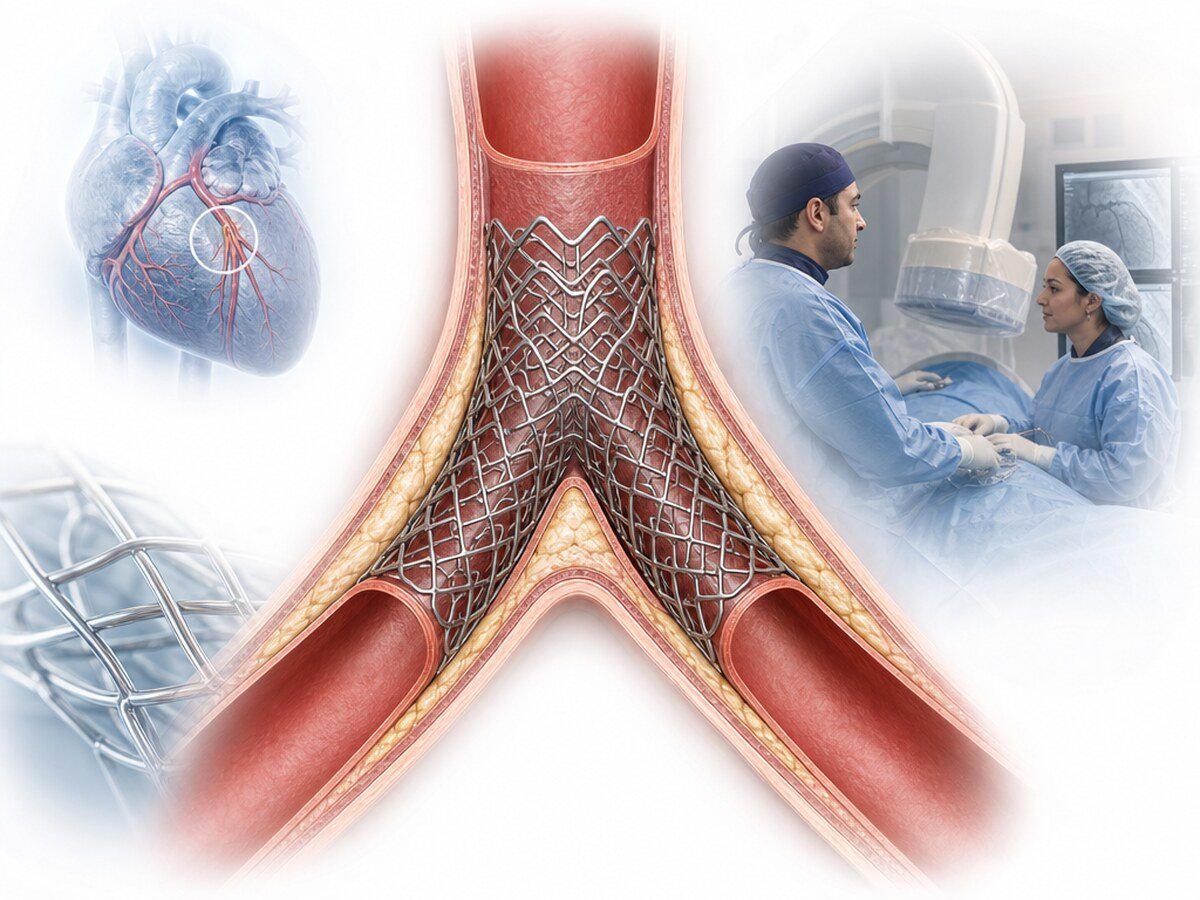
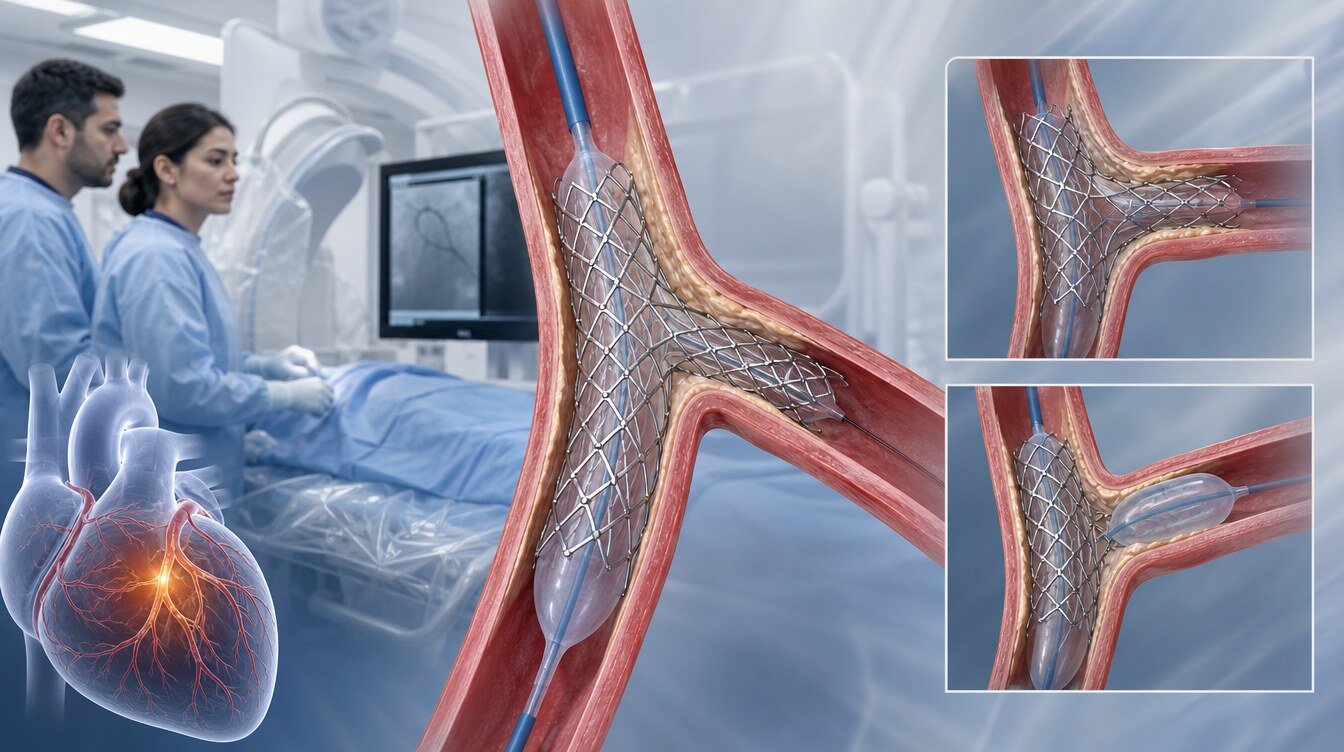
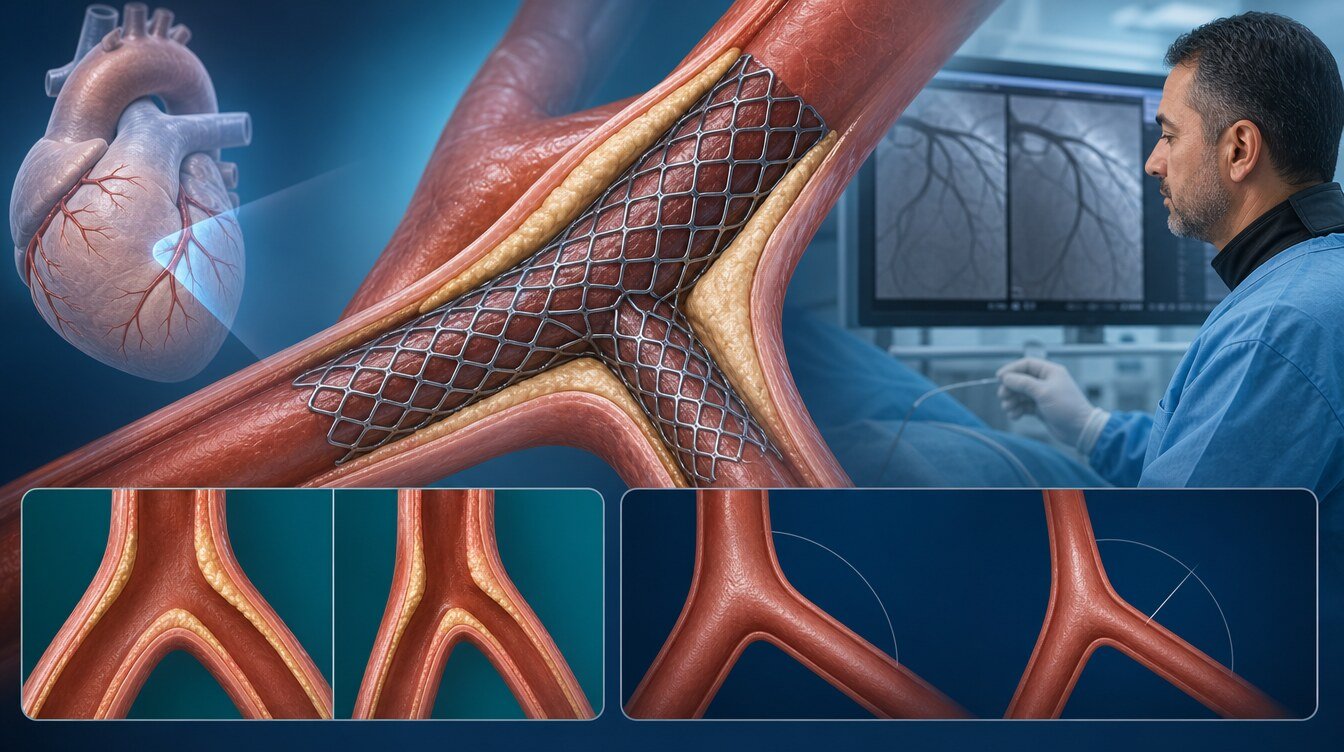
Culotte is a planned (or bailout) two-stent technique that fully covers both branch ostia. The cost is a double metal layer in the shared proximal main vessel. The EBC notes that long segments and multiple strut layers are associated with increased stent-failure risk and can make kissing harder; it advises reducing overlap in DK crush and DK culotte.[1]
Parent: bifurcation and LMCA interventions.
What does culotte mean?
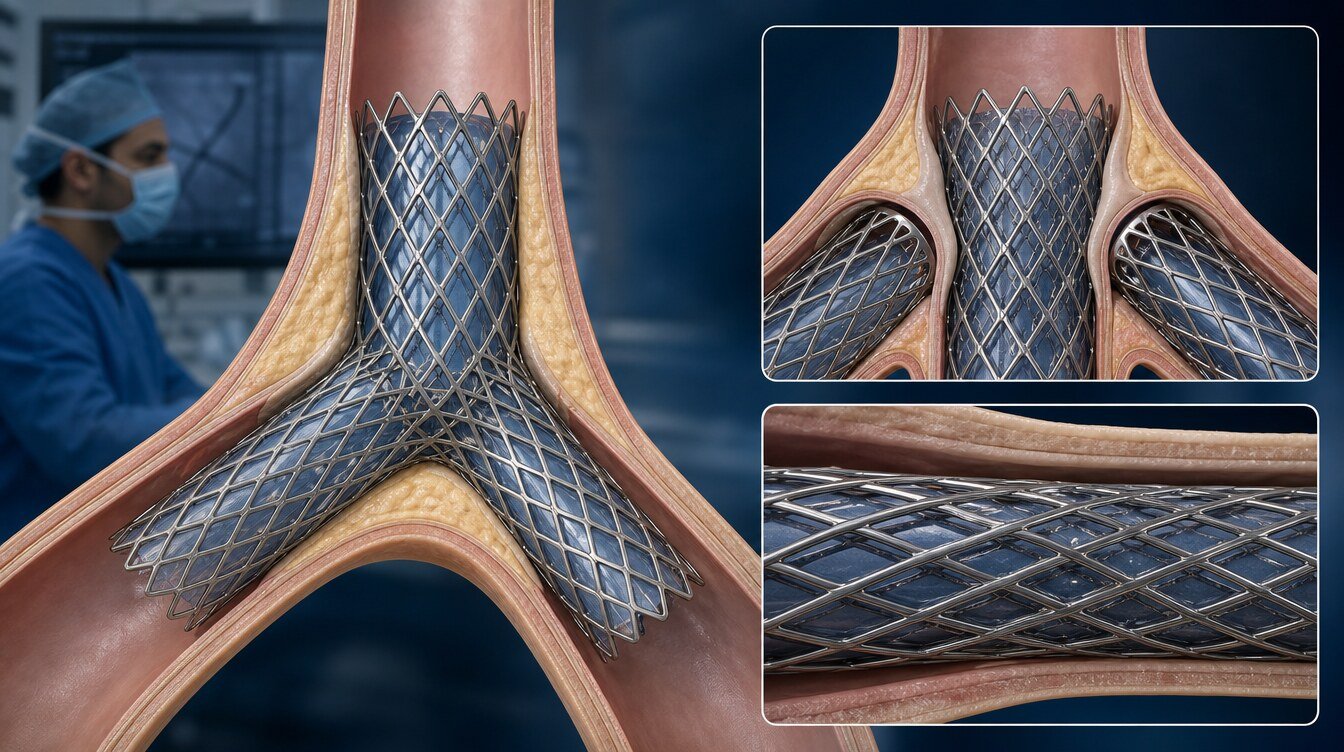
Two stents scaffold both branches. Metal overlaps in the shared proximal segment. Vessel calibre and angle affect suitability; no size recipe is published. Operator steps are not given here.[1]
What was found versus crush?
The Nordic Stent Technique Study randomised 424 patients to classic crush or culotte. Six-month MACE was 4.3% versus 3.7% (p=0.87). Eight-month in-stent restenosis was 10.5% versus 4.5% (p=0.046). At 36 months the primary endpoint was 20.6% versus 16.7% (p=0.32). The angiographic difference did not become a clinical difference. It is a first-generation sirolimus-stent era trial.[2,3]
DKCRUSH-III randomised 419 patients with unprotected distal left main bifurcation lesions to DK crush or culotte. One-year MACE was 16.3% with culotte versus 6.2% with DK crush; at three years 23.7% versus 8.2% (the same 419 people). The direction is the opposite of Nordic. Classic crush versus DK crush, and general bifurcations versus unprotected left main, are not like-for-like.[4,5]
The DK crush page also reads this left-main comparison from the DK crush side.
Was it compared with a provisional approach?
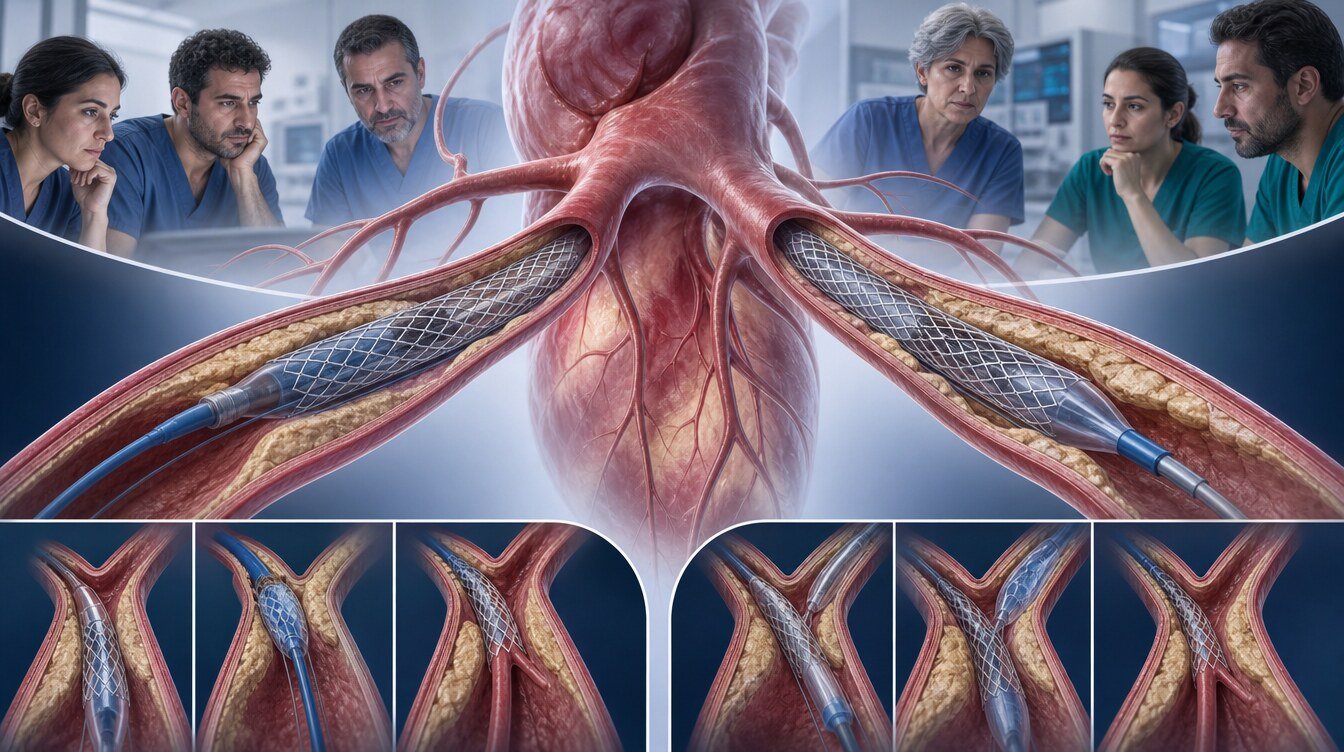
EBC TWO randomised 200 large-calibre true bifurcations across 20 European centres to provisional T-stenting or systematic culotte. The 12-month composite was 7.7% versus 10.3% (p=0.53). At five years 18.4% versus 23.7%, with no significant differences in death, MI, TVR or stent thrombosis. With 200 patients the trial cannot exclude clinically meaningful differences. It is not proof of equivalence.[6,7]
“Complex” arms in Nordic-Baltic IV and BBC ONE mixed culotte with other techniques; they are not named-culotte tests.
Is DK culotte better than DK crush?
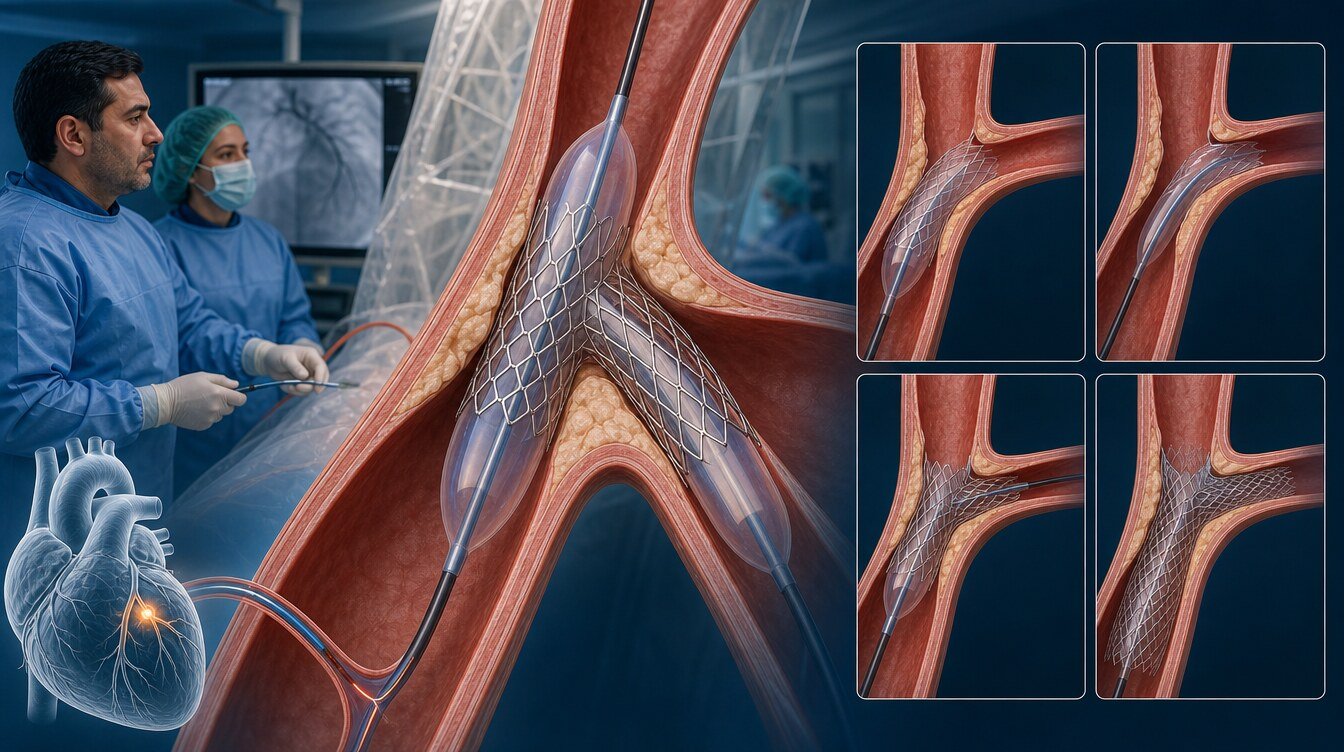
That must not be written as a conclusion. ROUTE, in 202 consecutive non-left-main patients allocated by operator preference, found 1-year target lesion failure of 10.9% with DK crush versus 3.0% with DK culotte. In the MAIN-ROUTE left main registry, 3-year TLF was 11.3% versus 5.0% (HR 0.557; p=0.06) and did not reach significance. Both are observational; confounding by indication cannot be excluded. They are not randomised superiority.[8,9]
Risks and emergency warnings
Culotte carries the risks of stent treatment and bifurcation PCI. No Class/LOE is invented here. Call 112 for bleeding that will not stop, severe chest pain that does not settle, or impaired circulation in the access limb.[10]
Frequently asked questions
This package does not show that culotte reduces death.
EBC TWO found no difference; 200 patients is not proof of equivalence.[6]
When full coverage of both ostia is wanted and calibre and angle are suitable; the decision is individual.[1]
No culotte-specific Class/LOE was found in this package; the frame is consensus.
Nordic used first-generation DES; transfer to contemporary practice is limited.[2]
For bleeding that will not stop, severe chest pain that does not settle, or a cold or numb limb on the puncture side.[10]
Assessment and decision
Culotte is a two-stent option that fully covers the ostia. There is no universal ranking versus crush. An observational DK culotte signal is not randomised superiority. The decision is discussed with anatomy and experience alongside provisional stenting or other two-stent paths.[1,2,4]
Literature
References
Burzotta F, et al. EBC 18th consensus. EuroIntervention. 2024. DOI: 10.4244/eij-d-24-00160.
Erglis A, et al. Nordic Stent Technique Study. Circ Cardiovasc Interv. 2009. DOI: 10.1161/circinterventions.108.804658.
Kervinen K, et al. Nordic Stent Technique 36-month. 2013. PMID: 24262616. Same cohort; journal/DOI not verified in this package.
Chen SL, et al. DKCRUSH-III. J Am Coll Cardiol. 2013. PMID: 23490040. DOI not verified in this package.
Chen SL, et al. DKCRUSH-III 3-year. JACC Cardiovasc Interv. 2015. PMID: 26315736. Same 419 patients.
Hildick-Smith D, et al. EBC TWO. Circ Cardiovasc Interv. 2016. DOI: 10.1161/circinterventions.115.003643.
Arunothayaraj S, et al. EBC TWO 5-year. EuroIntervention. 2023. DOI: 10.4244/eij-d-23-00211. Same cohort.
Kahraman S, et al. ROUTE. Circ Cardiovasc Interv. 2024. DOI: 10.1161/circinterventions.124.014616. PMID: 39445416.
Erturk M, et al. MAIN-ROUTE. Adv Interv Cardiol. 2025. DOI: 10.5114/aic.2025.154307. PMID: 41114310.
NHS. Coronary angioplasty — Recovery. Official patient page. Accessed 27 August 2026.
This content is for general information only and does not replace personalized medical advice. In emergencies call local emergency services.
Continue