
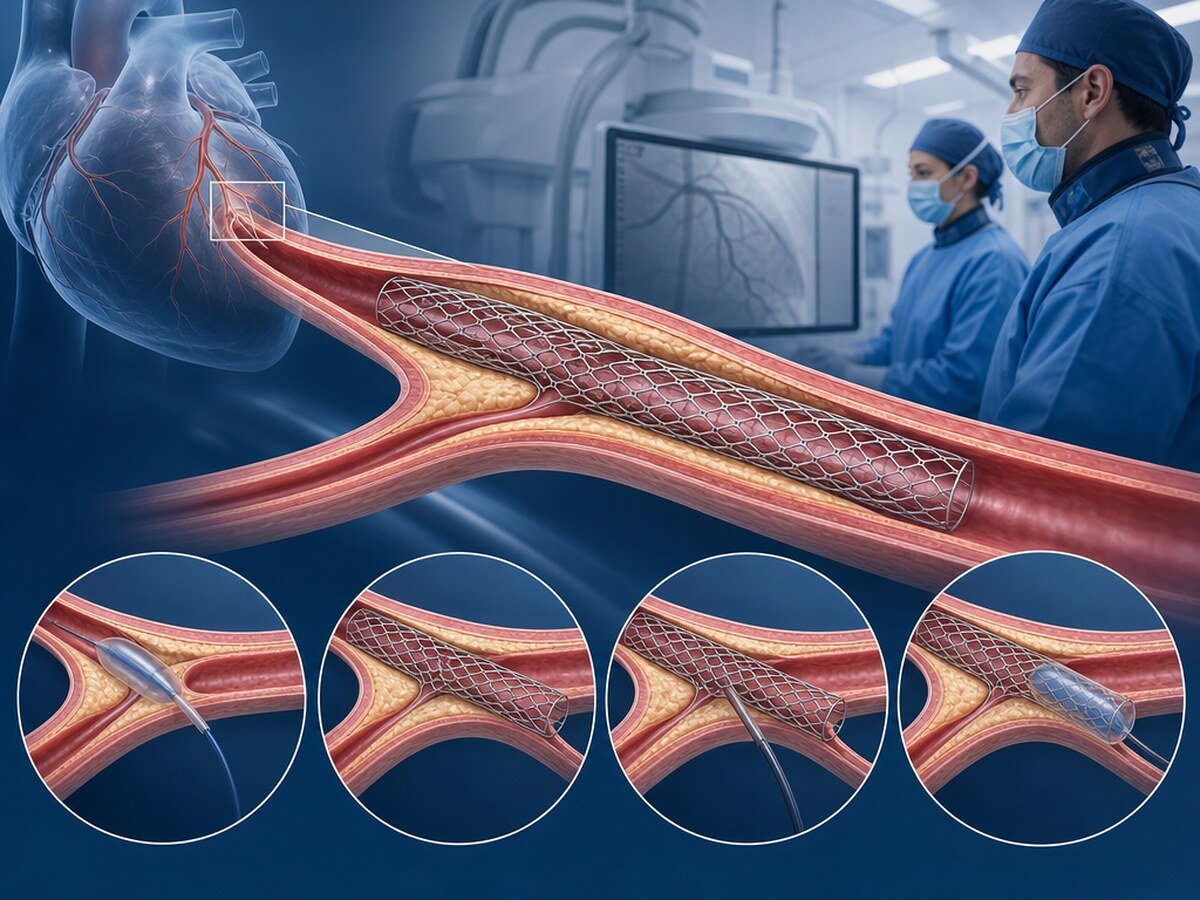
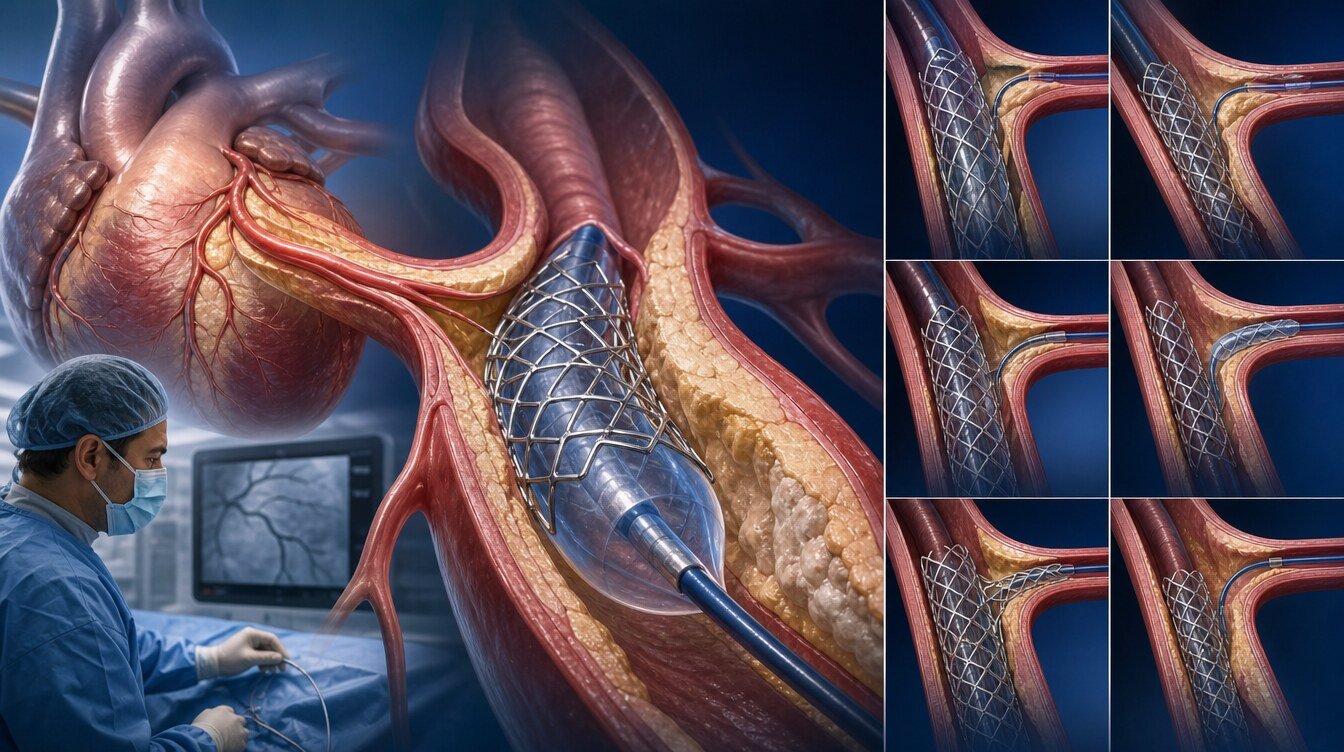
Provisional (conditional) stenting is a treatment philosophy that starts with one stent in a coronary bifurcation; it is not a fixed “one-stent technique” or a guarantee. The aim is to reconstruct the main vessel from proximal to distal across the side-branch opening, then match the proximal segment with proximal optimisation (POT). A second stent is added only if the side branch clearly needs it.[1]
Parent overview: bifurcation and LMCA interventions.
What does a provisional approach mean?
The EBC 16th consensus treats it as a philosophy rather than a technique: one stent, the side-branch wire left in place (jailed wire), then systematic POT. Balloon diameter, pressure or a step-by-step operator list does not belong on a patient page.[1]
In whom is it preferred?
Consensus recommends stepwise provisional for the vast majority of non-true non-left-main bifurcations and for true non-left-main lesions with side-branch lesion length under 10 mm. The 10 mm figure is a consensus boundary, not a validated cut-off that decides the case on its own. A one-stent approach may also be appropriate for true bifurcations with shorter side-branch lesions; EBC MAIN is cited in that frame.[1]
Planned two-stent options are described on DK crush, culotte and, when needed, T-stenting.
What are the conceptual steps?
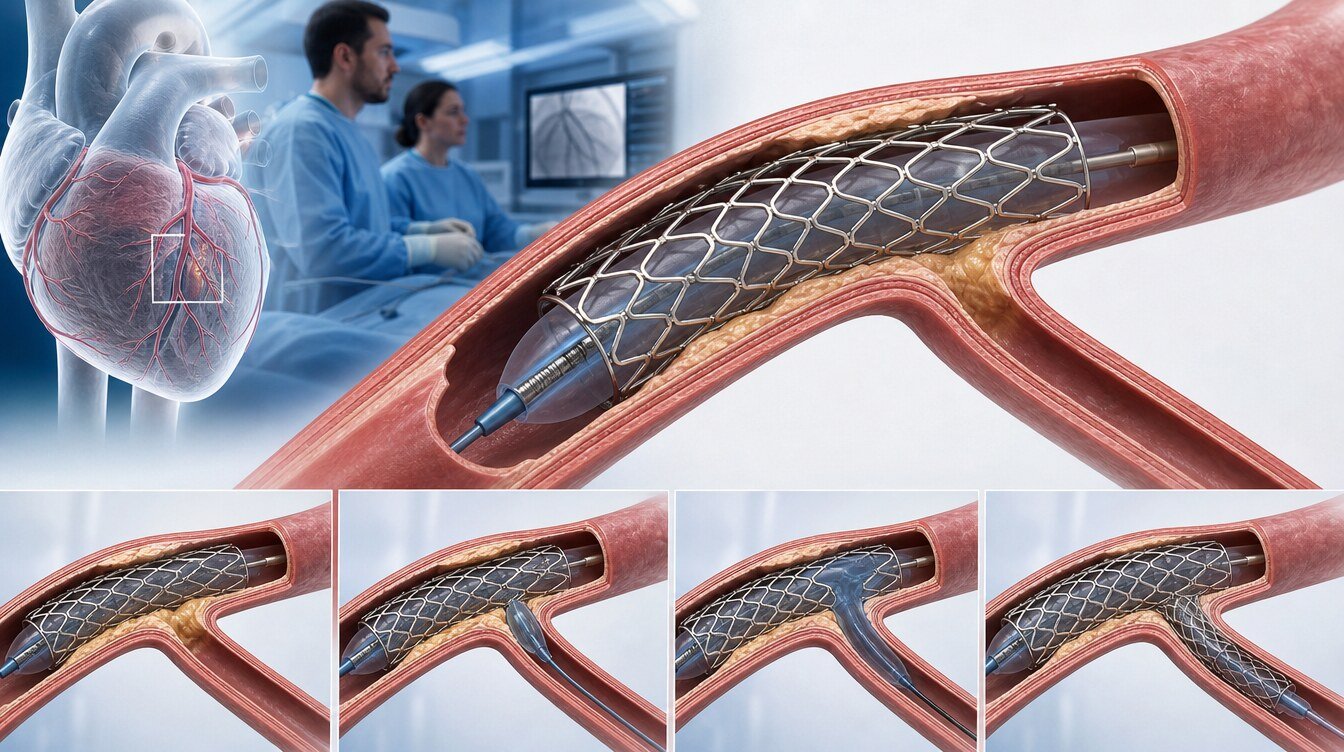
At patient level the sequence is:[1,2]
- Main-vessel stent: It covers the side-branch take-off (crossover). The side-branch wire may be left in place.
- POT: The proximal main vessel is matched to its calibre with a balloon seated immediately proximal to the carina.
- Rewiring the side branch: Consensus describes a distal crossing close to the carina as more favourable.
- Balloon if needed: Opening the side branch or kissing inflation.
- Second stent if needed: Options include T, TAP or culotte; no operator recipe is given here.
When is a second side-branch stent considered?
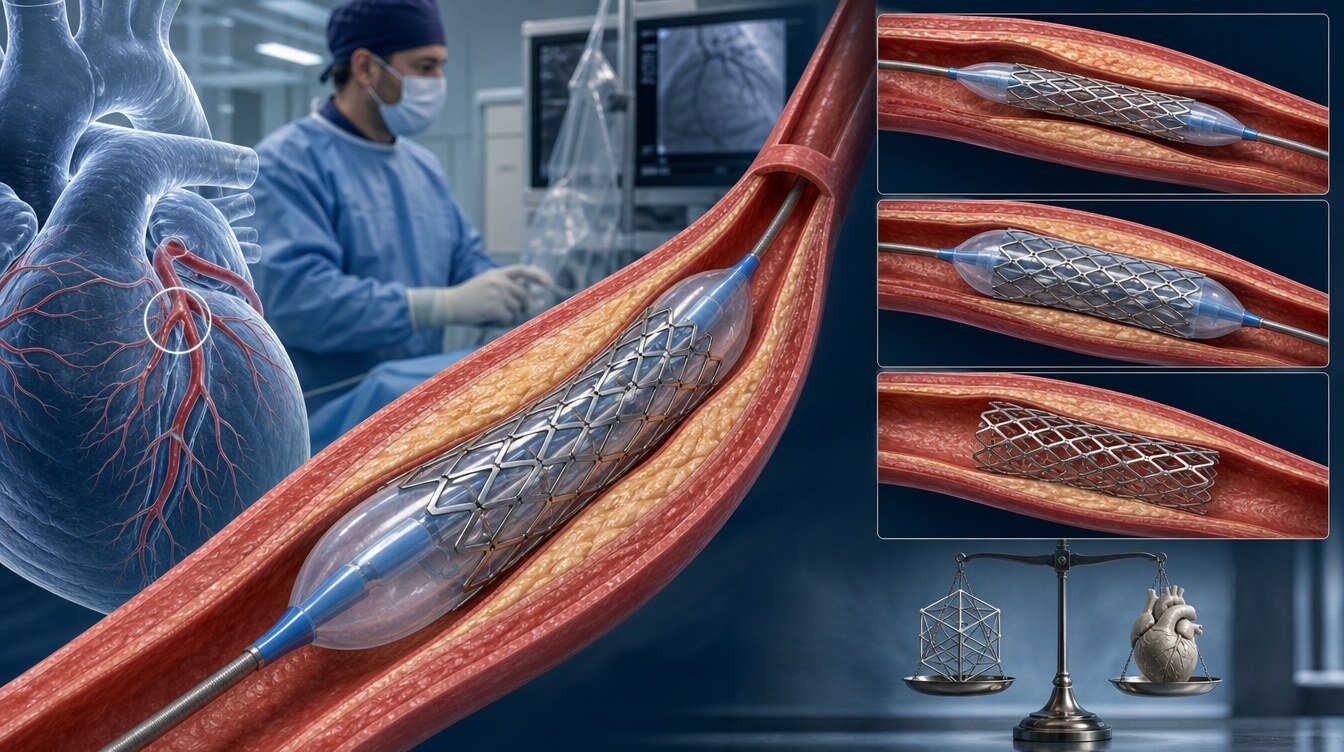
The EBC 18th consensus lists three conditions supporting side-branch stenting after main-vessel stenting: impaired TIMI flow; stenosis over 70% with angina and/or ECG changes; and extensive dissection greater than type B. The same table states the side branch should not be stented by default.[2]
Trial protocols used related but non-identical thresholds. Nordic-Baltic IV used 75% residual ostial stenosis; DKCRUSH-VI used 70% in its angiography-guided arm. These numbers are not interchangeable universal rules and are not turned into patient instructions.[2,4,5]
What does kissing balloon inflation do?
Nordic-Baltic III randomised 477 patients to final kissing or none after main-vessel stenting. Six-month major events were 2.1% versus 2.5%. At eight months side-branch restenosis was 7.9% versus 15.4% (p=0.039), and 7.6% versus 20.0% in true bifurcations. The angiographic side-branch result improved without a measurable short-term clinical difference. Angiographic restenosis is a surrogate. Kissing balloon inflation must not be said to reduce heart attack or death.[6]
Can physiology show whether the side branch needs a stent?
DKCRUSH-VI randomised FFR-guided against angiography-guided provisional stenting. Side-branch stenting was attempted in 38.1% of the angiography arm versus 25.9% of the FFR arm; the 1-year composite was 18.1% in both. Fewer stents, the same clinical rate. A single trial of this size cannot exclude a modest difference. Physiology has not been shown to improve survival.[5]
What are the limitations?
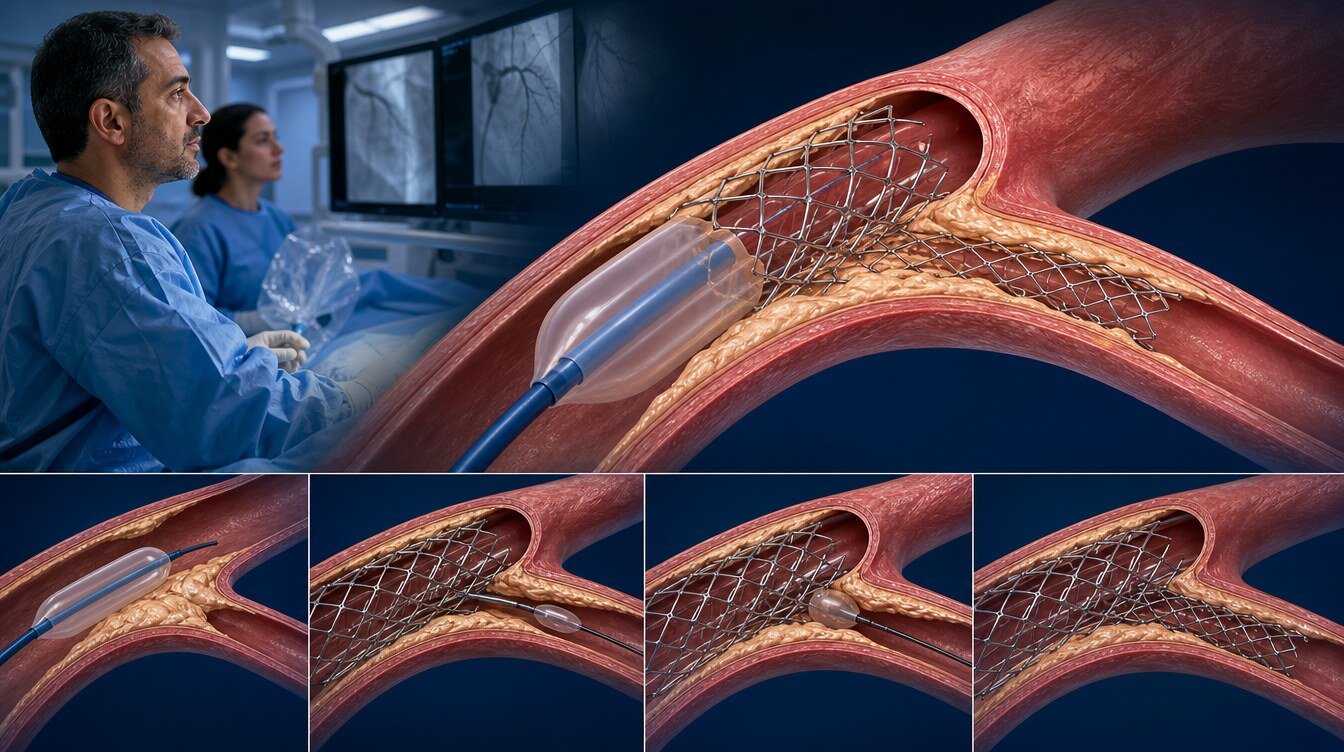
Crossover from provisional to a second stent varied widely: 3.7% in Nordic-Baltic IV, 28.6% in DKCRUSH-II, and 31% of provisional lesions in CACTUS. Anatomy and thresholds differ; these rates must not be averaged into a single “one-in-five rule”. The parent page’s approximately 20% figure is the EBC summary of randomised experience, not a separate pooled estimate.[4,7,8]
Older trials (BBC ONE, Nordic I, CACTUS) predate contemporary drug-eluting stents and routine POT. Mixed-technique arms test a strategy, not a named technique.

Risks and emergency warnings
Provisional PCI carries the risks of stent treatment and coronary angiography. POT or kissing is not a survival promise. Call 112 for bleeding that will not stop, severe chest pain that does not settle, or impaired circulation in the access limb.[9]
Frequently asked questions
No. The philosophy is to start with one stent; a second may still be needed.[1]
No. Consensus says the side branch should not be stented by default; poor flow, symptoms/ECG changes or extensive dissection support adding one.[2]
Nordic-Baltic III found no six-month clinical difference; the angiographic side-branch result improved.[6]
DKCRUSH-VI reported fewer side-branch stents and the same one-year event rate; a survival difference was not shown.[5]
For bleeding that will not stop, severe chest pain that does not settle, or a cold or numb limb on the puncture side.[9]
Assessment and decision
Provisional stenting is the starting plan for most bifurcations. The decision is renewed with the live side-branch result, imaging and centre experience. A second stent is part of stepwise treatment, not a failure label.[1,2]
Literature
References
Albiero R, et al. EBC 16th consensus, part I. EuroIntervention. 2022. DOI: 10.4244/eij-d-22-00165. PMID: 35570748.
Burzotta F, et al. EBC 18th consensus. EuroIntervention. 2024. DOI: 10.4244/eij-d-24-00160.
Hildick-Smith D, et al. EBC MAIN. Eur Heart J. 2021. DOI: 10.1093/eurheartj/ehab283. PMID: 34002215.
Kumsars I, et al. Nordic-Baltic Bifurcation Study IV. Open Heart. 2020. DOI: 10.1136/openhrt-2018-000947.
Chen SL, et al. DKCRUSH-VI. JACC Cardiovasc Interv. 2015. PMID: 25819187. DOI not verified in this package.
Niemela M, et al. Nordic-Baltic Bifurcation Study III. Circulation. 2011. DOI: 10.1161/circulationaha.110.966879.
Chen SL, et al. DKCRUSH-II. J Am Coll Cardiol. 2011. DOI/PMID not verified in this package.
Colombo A, et al. CACTUS. Circ Cardiovasc Interv. 2009. PMID: 19103990.
NHS. Coronary angioplasty — Recovery. Official patient page. Accessed 27 August 2026.
This content is for general information only and does not replace personalized medical advice. In emergencies call local emergency services.
Continue